
Knowing the underlying science of habit formation can help us create good habits and break bad ones. The habit loop has four simple steps: cue, craving, response, and reward. Understanding these four steps will help you figure out what habits are, how they work, and how to change them.
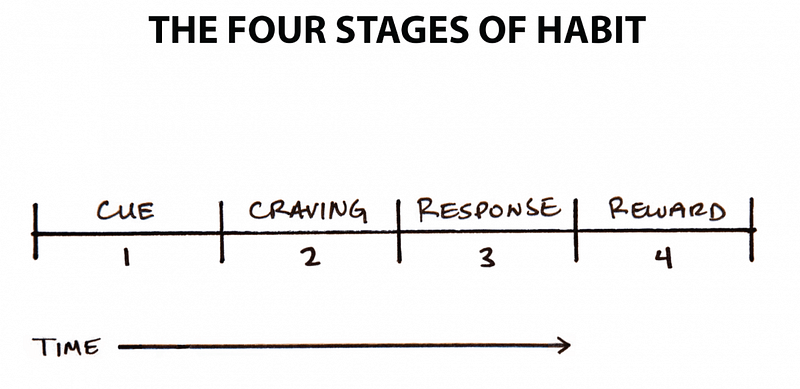
The Four Steps of Habit Formation
Cue
The cue is the stimulus that sets off the behavior. It’s a piece of information that predicts a reward. For our prehistoric ancestors, cues might indicate primary rewards, such as food or water. In the modern world, a cue could indicate secondary rewards, such as money, fame, or a personal sense of worth.
Craving
Every habit is fueled by a craving. Without the desire for a change of state, there’s no reason to act. We don’t crave the behavior of brushing our teeth. We crave the change of state that that behavior delivers. We don’t crave the action, but the feeling. Why do we hold on and not let go?
Response
The response is the actual habit you perform, in thought or in action. Whether the response will occur depends on the motivation you have, and the friction linked to the behavior. If you’re feeling tired (low motivation), and your running shoes are buried in the belly of your closet (high friction), you’re much less likely to go for a jog — but high motivation and low friction will make the response more likely.
Reward
The reward comes at the end of every habit, and its purpose is twofold: To gratify your craving and to signal to your brain whether a behavior has been worth remembering for the future. A behaviour that is not adequately rewarding, a habit that never becomes ‘own-able’, will not become etched into your brain. The pleasant feeling of knowing you’ve given your muscles a good workout will reinforce your exercise habit.
The Habit Loop
The four stages of habit create a feedback loop that scans the environment, predicting what will happen next, trying out different responses, and learning from the results. It’s like a mini-I that operates at lightning speed, running on automatic overnight.
We can break these four steps down into two phases: the problem phase and the solution phase. The problem phase consists of the cue and the craving — when you figure out that something’s gotta give. The solution phase includes the response and the reward — when you do give something, and get the change that you need.
The Four Laws of Behavior Change
These stages translate into the Four Laws of Behavior Change, a useful strategy for building good habits and breaking bad ones:
- Make it obvious: Design your surroundings in such a way that your cues about good habits are obvious and visible, like keeping a book you want to read on your pillow.
- Make it attractive: Temptation bundling is a terrific strategy to combine an activity you enjoy with one you have the motivation to avoid. You watch your favorite show only when exercising.
- Make it easy: Reduce the friction associated with good behavior. If you want to exercise, leave your workout clothes out.
- Make it satisfying. Reinforce the behavior to make it rewarding, so that tracking your progress and celebrating small successes will enhance the habit.
Conclusion
If you know the rules and apply them, you can use your environment and your habits to change and, ultimately, improve your life. Habits matter. They are what help us get through the day, every day. Understanding how they work gives us the power we need to effect real, meaningful change.
Knowledge understood from:
Atomic Habits: An Easy & Proven Way to Build Good Habits & Break Bad Ones