
Not too much extrovert, not too much introvert
Sitting at the boundary between extroverts and introverts, we ambiverts can feel as if we don’t belong anywhere. Somewhere between the 10th and 90th percentiles on the ‘extroversion’ scale, ambiverts are those of us who have tough skin and thick fur but also are as affectionate with our mates as wolves. We’re the happy medium personified — switching with apparent ease between the outside and the inside.
The Spectrum of Personality
To understand this paradox, it is useful to first consider the full prevalence of personality continuity. Extroverts are people who are energized by social encounters and thrive in fast-paced, stimulating, and busy environments. They are usually outgoing, conversational, and proactive. However, introverts thrive on being alone. They de-stress and recharge in quiet environments, tend to meditate, and prefer to have in-depth conversations rather than small talk.
But the extroversion/introversion typology presents itself, by nature, as binary; Carl Jung, the Swiss psychiatrist who defined the terms, accepted that most people fall somewhere between the extremes and that everyone is to some extent both types, creating a bipolar distribution such that the great majority of people lie towards the middle.
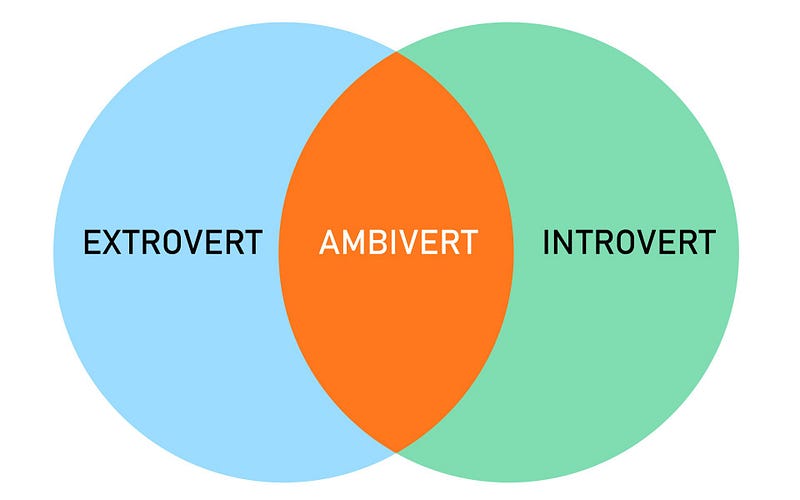
The Ambivert Advantage
Ambiverts are just social shapeshifters; while they might be someone outgoing and chatty at a party, they’re equally happy curled up in bed with a good book. That adaptability is what gives them many of the personal and professional benefits of both introverts and extroverts.
The ambivert can become an acrobat in a social setting because ambiverts are adept at listening as well as talking. They are as comfortable starting a conversation as they are backing off and letting a lull speak for itself. This seemingly opposing array of skills can prove pragmatic because it makes an ambivert an agreeable companion without compromising their own peace of mind. They are easy to know but not so easy to figure out; they are always available but never annoy you with their presence.
At work, ambiverts often thrive because they are able to handle the different demands of different kinds of tasks and environments. They work well with others, using both insight and enthusiasm in a team context, but they can also be independent, focused, and self-motivated when that’s what the task requires. They make good salespeople, for example, because they know when to push and when to pull, responding to the needs and feedback of their clients.
The Struggles of Ambiguity
While ambiverts gain some benefits from their chameleon-like nature, they also come at a cost. For one thing, ambiverts can be quite difficult to read. They can have moments of great warmth, then drop back into subdued silence. The constant turmoil within ambiverts can make them confusing to both themselves and others.
Sometimes, others expect that their ambivert friends will simply decide whether to be extraverted or introverted on a daily basis, never seeming to recognize that ambiverts will often start, or end, the day in the middle. Their friends might want ambiverts to always be outgoing, or never stop being up for anything, or suddenly need them to retreat to be alone, and it simply doesn’t work that way. Relationships can suffer because others might just not know what their ambivert friends need.
While inwardly an ambivert can be torn between urges to be around others and enjoy a small circle of best friends, on the other hand, they might naturally prefer to be alone, battling a relentless need for social contact. Working in a total extrovert environment can result in restlessness and dissatisfaction and an ambivert might still feel out of sorts operating in a system that’s social in every aspect. You never feel pure-blooded one way or another: neither admit nor interest you 100 percent.

Embracing the Ambivert Identity
For ambiverts, the path to thriving runs through self-awareness and self-acceptance. Understanding that your own personality occupies a wide area on the curve can help you relate more productively to your internal and external environments. Harness the insight your brain has provided you. Notice your own needs and ask for them clearly.
Secondly, they should strive for flexibility: knowing they are in a unique position, ambiverts can capitalize on their flexibility in order to create environments that are better suited to their varied requirements in a single role. In other words, ambiverts should set limits with respect to socializing, develop a schedule that includes both social and solo activities, and seek out roles or situations in which they can interact and work independently.
The ambivert, with their paradoxical heart, has feet in two different worlds: they draw on the social flower of the extrovert and the poetry of the introvert, too. By refining what works and shedding what does not, this unusual case study has the potential to offer all of us an everyday resolution that feels true to who we are.
Yes, they can charm a crowd and handle the social priority-heaped inbox. But they can also be alone with their thoughts and content. Now isn’t that something to be admired?