
Doing all that we can with the intensity to which we care is how we’re usually advised to achieve any goal.
There’s a paradoxical counter-narrative to this ‘try as hard as you can’ advice: sometimes, the less we care, the more results show up. It’s a paradox with as many footnotes as there are people who have practiced it in different walks of life, from creativity to crisis performance to spiritual fulfillment. This piece explores the curious idea that, when you stop caring, results tend to show up.
A writer suffering from writer’s block is a perfect example. Unable to think of her next idea, she experienced the difficulties of forced effort: the more effort she put in, the harder it was to actually create. It was only when she let go of the pressure to come up with anything that she had an idea, showing that non-striving is often the best way to be creative.
There IS something to this, by the way: it is a version of what the writer Aldous Huxley called the ‘Law of Reverse Effect’, by which:
The harder you work at something (eg, trying to be Buddha-like), the less likely you are to succeed.
The Buddhist parable of the merchant, who always wanted the sage to admire him, perfectly illustrates this tendency to tarnish our shine. Most of us know to stop trying to make Keith Richards like us. For the person who needs to show off or impress, the statement backfires. This conveys a profound truth about human psychology. The more we care about people liking us, the less we actually like ourselves.
The Nervous Archer
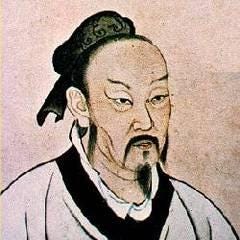
The parable of the nervous archer in Zhuangzi encapsulates the damage that can result from caring too much about the outcome. The more we think about future results, the more we cause ourselves to feel tight and bogged down with tension and expectation — feelings that hinder performance. To be open and receptive is instead to tune in with the rhythms of the cosmos, allowing the intention side and the action.
Explained
The Mental Control Paradox explains more concretely why attempts to suppress negative thoughts often result in the opposite of what we want: fighting with a negative emotion often leads to that emotion getting even stronger. A large amount of research has shown us that, on a fundamental level, our efforts at thought suppression fail. In other aspects of our lives, too, creativity benefits more from surrendering to your instincts and processes than it does from trying to control them. Roseanne’s character was right: ‘Whatever you’re thinking, stop.’
The Wu Wei Style
The ancient Taoist concept of ‘wu wei’, or effortless action, celebrates the potency of non-striving, which flows from the idea that excessive exertion creates the goals it ought to overcome. Stepping into ‘the zone’ in sports relies on this principle: allowing ourselves to stop pushing in favor of letting things happen. Wu Wei cultivates a quality of presence in which past and future cease to create suffering by dictating what is and what will be, and enabling the ease with which we can respond freely to what is actually here.

Whether it’s a task at work, heading to the gym, catching up on writing, or simply taking it easy on yourself, the path isn’t more painful if you think of it as a journey instead of your homework. Go through your to-do list with curiosity instead of obligation. Stop seeing your tasks as things to do and see them as experiments to try. Just like the writer above stopped pressuring herself to create and, as a result, found herself capable of creative insight again, your disposition is not the barrier to mastering the things you want to do. Caring less will actually help you care more, and care better.
I write because doing so fills me with joy and allows me to breathe more deeply; I write to explore an idea or feeling, to find my words, and to gain a fresh perspective on things. Though I don’t write because I’m trying to be a celebrated novelist, nor is it a practice for writing book reviews, I write because it fills me with a sense of accomplishment and fulfillment.
I go to the gym because I like that feeling of endorphins after a good session, because it makes me feel good about myself, and because I’m looking to get healthier. But I’m not trying to get rock-hard abs. I also don’t run because, according to Pentecostals, running regularly translates to ‘running from my sins’. When your mother is a Pentecostal pastor, you’d be forgiven for trying to steer clear of running as much as possible.
I work because I like going to work and because I want to be part of something meaningful. But I don’t work because I have to. I don’t try to perfect things, nor do I beat myself up when I feel I’m not doing enough. It can be painful when you feel like you’re not measuring up to others. You find yourself wanting to accomplish more but feeling trapped by your own limitations. Ultimately, the relief comes from caring less.